
Ground Transport vs Flight Nanny: How Safe Frenchie Delivery Is Chosen
Choosing how a French Bulldog puppy will travel home is not just a question of convenience. A short, well-managed trip can still involve stress, temperature changes, missed meals, unfamiliar handling, and delays. Because French Bulldogs have short muzzles and may be more vulnerable to heat and breathing strain, transport plans deserve extra care. Ground Transport vs Flight Nanny: How Safe Frenchie Delivery Is Chosen comes down to the individual puppy, the route, the weather, and the quality of supervision—not a claim that one method is always safest.
This guide gives you a practical way to compare private ground transport with a flight nanny who accompanies a puppy in the aircraft cabin. You will learn what information to collect, which health and age considerations matter, how to evaluate a provider, what a responsible breeder should coordinate, and what to do if travel plans change. You will also get questions to ask before you reserve a transport arrangement and signs that a plan needs to be reconsidered. The goal is a calm, transparent handoff that prioritizes the puppy’s welfare over speed or convenience.
Start with the puppy, not the transport label
“Ground” and “flight nanny” describe ways to travel, but neither term guarantees safe handling. A private vehicle with frequent checks can be a better fit for one puppy, while a supervised cabin flight may be more reasonable for another route. The decision should begin with the puppy’s age, current health, temperament, veterinary advice, and ability to cope with the proposed journey.
French Bulldogs are brachycephalic, meaning their shortened facial structure can affect airflow and their ability to cool themselves efficiently. Individual dogs vary, so a breed label cannot predict how a particular puppy will respond. Ask the breeder and veterinarian to discuss the puppy’s breathing, recent examination, feeding routine, stress response, and any health concerns before anyone books travel.
- Confirm the puppy meets applicable age and vaccination requirements for the proposed trip.
- Ask whether a veterinarian has assessed the puppy’s fitness to travel.
- Discuss the puppy’s breathing, appetite, stool, energy, and ability to settle.
- Consider the full door-to-door time, including waiting, transfers, and possible delays.
- Change the plan if the puppy is unwell, unusually distressed, or exposed to unsafe weather.
A safe decision may be to postpone, arrange a shorter journey, or have the buyer collect the puppy in person. Responsible transport is flexible; it does not force a puppy to travel simply because a ticket or vehicle has already been booked.
What a Frenchie’s short muzzle changes during travel
French Bulldogs can be more sensitive to heat, exertion, and respiratory stress than many longer-muzzled dogs. That does not mean every Frenchie will have a travel problem, nor does it mean air or road travel is automatically inappropriate. It does mean that temperature control, ventilation, calm handling, and close observation should be part of the plan.
Heat and humidity need active management
Warm conditions can raise the risk of overheating, especially when a puppy is anxious, confined, or waiting in a vehicle or terminal. A carrier or vehicle should never be left in direct sun or without reliable temperature control. If a route includes hot-weather exposure, ask the provider to explain how they avoid outdoor waits and what they will do if cooling or ventilation fails.
Stress can affect breathing and behavior
New sounds, motion, handling, and separation from familiar people can cause a puppy to pant or struggle to settle. A transport handler should know the puppy’s normal breathing and behavior well enough to recognize a meaningful change. Avoid plans that depend on sedating a puppy for convenience; medication decisions belong to a veterinarian who knows the puppy and the journey.
Crates and carriers must fit the actual puppy
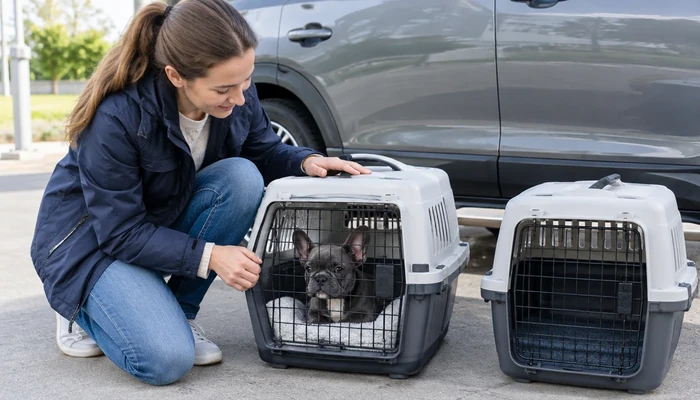
The carrier should allow a natural resting posture, with enough room to turn and lie comfortably, while still providing secure containment. Ask about ventilation, access for observation, absorbent bedding, and how the carrier is secured. Do not assume a carrier is suitable just because it meets a carrier rule or fits a vehicle.
For background on how inherited traits and individual variation can shape a Frenchie’s health, see the role of genetics in French Bulldog health. Transport decisions should still be made for the individual puppy, with veterinary input where appropriate.
Ground transport and flight nanny: what actually differs?
Ground transport usually means travel in a car or other road vehicle. A dedicated driver may carry one puppy or several animals, depending on the service. A flight nanny accompanies the puppy on a commercial flight, typically keeping the puppy in an approved carrier in the cabin. Policies vary by airline, aircraft, route, and carrier size, so the label alone tells you little about the actual conditions.
| Decision point | Ground transport | Flight nanny |
|---|---|---|
| Journey pattern | Can be direct, but long routes require breaks and careful scheduling. | May shorten distance time, but includes airport arrival, security, boarding, and possible delays. |
| Supervision | Ask who stays with the puppy and whether the driver transports other animals. | The nanny accompanies the puppy, but must follow airline and cabin rules. |
| Temperature exposure | Vehicle climate control and safe stops are central concerns. | Cabin conditions are managed by the airline, while airport waits and transfers still matter. |
| Rest and toileting | Stops can be planned, but location and sanitation require care. | Opportunities may be limited during flight and at busy terminals. |
| Disruption risk | Traffic, road closures, and vehicle problems can extend the trip. | Weather, cancellations, airline restrictions, and missed connections can disrupt plans. |
| Best comparison | Assess directness, breaks, vehicle conditions, and handler accountability. | Assess cabin eligibility, nonstop routing, nanny experience, and contingency plans. |
Compare the full journey rather than just the time in the car or air. A “short flight” can involve hours of airport waiting; a “direct drive” can be a long stretch without appropriate breaks. Request a written itinerary that includes every handoff and expected waiting period.
When private ground travel may be the better fit
Ground travel can offer flexibility and control, particularly when a route is manageable and the provider can keep the puppy in a climate-controlled vehicle with frequent observation. It may also avoid the sensory intensity of a busy airport. However, a long drive is not automatically gentler: fatigue, motion sickness, heat, traffic, and extended confinement can create their own risks.
Look for a puppy-centered road schedule
A responsible plan includes realistic travel blocks and safe, clean breaks. The handler should explain how they will offer water and meals according to the puppy’s routine, manage toileting without exposing the puppy to avoidable hazards, and keep the puppy secure while the vehicle is moving. Ask if the driver will transport other animals and how they prevent contact or cross-contamination.
Ask about vehicle and emergency readiness
Find out how the vehicle’s temperature is monitored, what happens if the air-conditioning fails, and whether the handler has a plan for a breakdown. Ask where the driver would seek veterinary help along the route. The provider should be able to share contact information, insurance details where applicable, and clear pickup and delivery procedures.
- Get the route, planned stops, estimated arrival window, and update schedule in writing.
- Confirm the puppy will not be left unattended in the vehicle.
- Ask how the carrier is restrained and kept away from direct sun or drafts.
- Request details about any other animals sharing the vehicle.
- Agree on what happens if traffic or weather makes the route unsafe.
Ground transport may be a poor choice if the journey is extremely long, the provider cannot explain supervision, or temperatures and delays cannot be controlled. In that case, compare a flight nanny or an in-person pickup rather than accepting vague assurances.
When a flight nanny may make sense—and its limits
A flight nanny can be useful when a puppy must travel a long distance and the airline permits the puppy to remain in the cabin with the accompanying adult. This arrangement may reduce time spent on the road. Yet it is not a private flight, and a nanny cannot control every airport or airline condition. Cabin policies, carrier dimensions, passenger limits, and animal acceptance vary.
Verify cabin eligibility before paying
Ask which airline and route will be used, whether the itinerary is nonstop, and whether the puppy’s carrier has been approved under the current rules. Confirm that the puppy is booked and accepted as an in-cabin animal, not as checked baggage or cargo. Obtain written confirmation and understand what happens if the airline changes the aircraft or refuses the carrier at check-in.
Account for the whole airport experience
The puppy may need to pass through security, wait at the gate, board, and travel through a new airport after landing. Ask where the puppy will remain during every stage and who keeps direct responsibility. A confident answer should cover delays, missed connections, cancellations, and the possibility that a flight becomes unsuitable due to weather.
Understand what a nanny can and cannot do
A flight nanny can observe and comfort the puppy within airline rules, but cannot provide a veterinary examination in the cabin or guarantee a smooth flight. They may not be able to remove the puppy from its carrier during flight. The plan should respect the puppy’s age, health, and normal care needs rather than promising special access that airline policy does not permit.
Before choosing, ask for the nanny’s name, experience with puppies and brachycephalic breeds, references, insurance arrangements, and written terms. Confirm whether the person booking the service will also be the person accompanying the puppy. If a company uses subcontractors, identify who is responsible at each handoff.
Build the decision around route, weather, and total time
Distance alone is an incomplete measure. A route with a longer mileage may be straightforward, while a shorter trip with a connection, hot airport transfer, or unreliable road schedule may add stress. Make a simple timeline from the puppy’s last familiar meal and rest period to the expected handoff at home.
Count every transition
List breeder pickup, travel to a station or airport, waiting, boarding, transfers, arrival, and the final drive. Each handoff adds a chance for confusion or delay. A direct trip with one accountable handler is often easier to evaluate than a chain of several providers, but directness alone does not establish safety.
Check seasonal and local conditions
Weather can affect both road and air plans. A heat wave may make roadside stops unsafe; storms can delay flights; winter conditions can slow a vehicle or disrupt airport operations. Ask what conditions trigger a postponement and who makes that call. The puppy’s wellbeing should take priority over a fixed delivery date.
- Write down the door-to-door estimate, not only the time in transit.
- Identify the warmest and coldest parts of the route.
- Note any connection, vehicle change, or overnight stay.
- Agree on a decision point for postponing if conditions change.
- Choose the option with a credible backup plan, not the most confident sales promise.
For families in the United States, routes can involve very different climates and distances. A provider should explain how the actual route will be managed instead of relying on a general statement that they transport puppies nationwide.
Age, health, and veterinary clearance come before booking
Transport timing must respect the puppy’s developmental needs and applicable law. Requirements can differ by state and transport method, and airline rules may be stricter than legal minimums. Confirm the puppy’s date of birth, records, identification, and eligibility before making a nonrefundable booking.
Request an up-to-date health record
Ask for the puppy’s veterinary examination record, vaccination and deworming history, microchip details if applicable, and instructions for follow-up care. A record does not guarantee that a puppy will remain healthy, but it supports a clear handoff to your veterinarian. The breeder should disclose any current symptoms or concerns rather than sending a puppy with unresolved illness.
Discuss fitness to travel with a veterinarian
A breeder’s experience is useful, but it does not replace a veterinary assessment. Ask whether the puppy has a condition, recent respiratory sign, poor appetite, diarrhea, or other issue that could make travel unwise. If a veterinarian recommends delaying the trip, follow that advice and review the contract or transport terms.
Do not medicate for convenience
Do not give sedatives, calming products, or human medication unless a veterinarian who knows the puppy has specifically directed it. Some drugs can affect breathing, balance, or temperature regulation. A transport company should never pressure you to medicate a puppy simply to make the journey easier.
Responsible breeding and early care can support a better start, but they cannot eliminate every health risk. For more about common breed health concerns, consult this overview of health problems seen in French Bulldogs. Your own veterinarian should advise on the puppy’s fitness for a particular trip.
Questions that reveal a transport provider’s standards
Clear, specific answers matter more than polished branding. Before you pay, ask the provider to explain their process in plain language and put key terms in writing. If answers change depending on who you speak with, pause and request clarification.
- Who will physically collect and supervise the puppy from pickup through handoff?
- Will the puppy travel alone, with other animals, or through multiple subcontractors?
- How often will you receive updates, and what information will each update include?
- How are temperature, ventilation, safe restraint, feeding, water, and toileting managed?
- What is the plan for a delayed flight, vehicle breakdown, cancellation, or severe weather?
- Who is authorized to seek veterinary care, and who pays for an emergency?
- What documents and identification will accompany the puppy?
- What refund, rescheduling, and cancellation terms apply if travel becomes unsafe?
A reliable provider does not promise zero risk. Instead, they explain foreseeable risks, name the person responsible, and describe how they will respond. For broader buyer education, the AKC guide to responsible dog breeding outlines practices that support thoughtful breeding and puppy placement. Use that broader framework alongside transport-specific questions.
Breeder coordination is part of the safety plan
The breeder knows the puppy’s routine and recent behavior, so they have an important role in organizing a safe handoff. They should share accurate records, explain feeding and sleep patterns, identify any concerns, and coordinate with the transport provider and buyer. Transport should not be treated as a final task that begins only after a deposit is paid.
Expect transparent information about the puppy
Before committing, ask how the breeder evaluates health, temperament, and parent dogs, and what information they provide about the puppy’s background. Health testing and thoughtful selection matter, but no breeder can guarantee a particular lifespan or prevent every condition. A responsible breeder explains both the work done and the limits of what it can predict.
Keep the travel plan consistent with early care
Ask the breeder to prepare a familiar blanket or bedding item if safe and appropriate, share the puppy’s usual food and schedule, and tell the handler about handling sensitivities. These details do not replace good transport, but consistency can help the puppy settle. Confirm that the handoff occurs at an agreed location with time to check records and the puppy’s condition.
Get the agreement in writing
The purchase contract and transport agreement should make responsibilities clear. They should identify who pays for the service, what happens during a delay, how medical decisions are handled, and when ownership and responsibility transfer. Read the terms before travel rather than trying to resolve unclear language during pickup.
Research on dog acquisition and breeding practices can add useful context. A peer-reviewed PLOS ONE study on dog acquisition and owner behavior offers evidence-based background for considering how sourcing decisions affect the experience of dogs and owners. It is not a transport protocol, so apply it as context rather than a substitute for veterinary guidance.
Records and handoff details to settle in advance
Good documentation reduces confusion if a trip is delayed or an unexpected question comes up. Keep digital copies accessible and make sure the handler has the information needed without relying on a text message that could be lost. The puppy’s safety depends on practical coordination as much as paperwork.
Prepare the puppy’s travel file
- Veterinary examination summary and relevant medical records.
- Vaccination and deworming dates, with the veterinarian’s contact details.
- Microchip or identification information, if applicable.
- Feeding instructions, usual meal timing, and any known sensitivities.
- Emergency contacts for the breeder, buyer, transport provider, and veterinarian.
- Written authorization and payment terms for urgent veterinary care.
Agree on the handoff process
Decide who will meet the puppy, how identity will be confirmed, and where the exchange will occur. Avoid vague plans such as “near the airport” or “at the end of the route.” At delivery, check that the puppy is alert, breathing comfortably, and able to move normally. If something seems wrong, contact a veterinarian promptly and notify the breeder and provider.
Keep updates useful and proportionate
Set a practical update schedule before the journey. A brief message at pickup, a mid-route update, and confirmation of arrival may be sufficient for a short trip; longer trips may need more frequent check-ins. Agree on what constitutes an urgent update so that a real concern is not hidden among routine messages.
Red flags that should pause the delivery plan
Some warning signs call for more questions; others justify walking away or postponing. A provider who is genuinely prepared should not object to reasonable welfare questions or written terms. Avoid allowing sunk costs or a promised arrival date to override concerns about the puppy.
- The provider refuses to identify the handler or explain who has custody at each stage.
- The plan involves cargo or checked transport without a clear, suitable arrangement and verified rules.
- No one can explain temperature control, carrier security, or emergency response.
- The provider promises that a French Bulldog puppy will have no breathing or travel risk.
- You are urged to sedate the puppy without veterinary direction.
- The puppy is described as unwell, but the provider insists travel must continue.
- There are no written cancellation, delay, or veterinary-care terms.
- Several handoffs are planned, but responsibility between providers is unclear.
A warning sign does not always prove misconduct, but it means you need verifiable answers before proceeding. If the answers remain vague, choose another provider, collect the puppy yourself if appropriate, or delay the trip. Ethical placement includes the willingness to change a plan when conditions are no longer suitable.
Preparing your home for arrival without adding travel stress
Home preparation supports the transition but should not become a reason to rush the journey. Have a quiet, temperature-controlled space ready, with water, familiar food, and a secure resting area. Keep the first evening simple. A tired puppy does not need a parade of visitors or a long outing immediately after travel.
Set up a calm first-day routine
Choose a safe place away from heavy foot traffic and strong heat. Prepare a suitable crate or pen before pickup and keep other pets separated at first. Ask the breeder what food the puppy has been eating, then make changes gradually with veterinary guidance rather than switching abruptly on arrival.
Plan a veterinary check after arrival
Arrange a new-puppy appointment according to your veterinarian’s advice and any contract requirements. Bring the records and note how the puppy behaved during travel, including appetite, water intake, breathing, stool, and energy. Seek urgent veterinary care if the puppy has labored breathing, collapse, marked weakness, repeated vomiting, or signs of overheating.
Allow recovery before training expectations rise
Give the puppy time to rest, explore gradually, and re-establish a routine. Gentle handling and predictable sleep, meal, and toileting schedules help create a calmer start. If the puppy remains unusually distressed or shows concerning symptoms, contact a qualified veterinarian rather than assuming the behavior is simply travel fatigue.
A practical decision framework for the final choice
There is no universal winner in a ground-versus-flight comparison. Use the same criteria for both providers, then choose the arrangement that best fits the puppy and route. If neither option has a credible welfare plan, postpone or arrange a different handoff.
- Confirm fitness: Review the puppy’s age, health record, and veterinary advice.
- Map the full route: Include waits, transfers, stops, and the final drive home.
- Check conditions: Assess temperature, ventilation, weather, and seasonal disruption.
- Verify supervision: Identify every handler and the person accountable for the puppy.
- Test contingency plans: Ask what happens if a flight is canceled or a vehicle becomes unusable.
- Compare written terms: Review costs, refunds, emergency care, and transfer of responsibility.
- Choose welfare over speed: Select the calmest feasible plan, even if that means waiting.
As an additional comparison point, assess whether the transport provider communicates openly and respects veterinary guidance. The best plan is not necessarily the cheapest or fastest. It is the one whose risks are understood, managed, and matched to the puppy’s needs.
When you are also evaluating the breeder, keep health and temperament ahead of appearance or urgency. Elite Frenchies shares information about its approach to puppy placement and support; you can review current puppy availability when you are ready to discuss a responsible next step. The same questions about health, records, and transport should apply regardless of where you choose to bring a Frenchie home.
Frequently asked questions about Frenchie delivery
Is ground transport safer than a flight nanny for a French Bulldog?
Not in every case. Safety depends on the puppy’s health and age, route, weather, provider, supervision, carrier, and total travel time. Compare the actual plans rather than relying on the method’s name.
Can a French Bulldog puppy fly in the cabin with a nanny?
Sometimes, if the airline accepts the puppy and carrier under its current rules and the puppy meets applicable requirements. Confirm the exact airline, itinerary, carrier dimensions, and in-cabin booking before paying. Policies can change.
Should a Frenchie puppy travel by cargo?
Do not assume cargo is appropriate for a French Bulldog puppy. Short-muzzled breeds may face additional concerns, and airline rules differ. Discuss the specific plan with a veterinarian and verify current carrier policies; consider alternatives if the welfare plan is uncertain.
How long can a Frenchie puppy travel?
There is no single safe maximum that applies to every puppy. Age, health, temperature, rest opportunities, and the nature of the route all matter. Ask a veterinarian to assess the proposed journey and avoid committing to a schedule that leaves no room for delay.
Should I give my puppy a sedative before the trip?
No medication should be given for travel unless a veterinarian who knows the puppy has specifically recommended it. Sedatives can affect breathing and other body functions, which is especially important to discuss for a brachycephalic breed.
What should the transport handler send during the trip?
Agree on updates in advance. Useful updates can confirm pickup, the puppy’s general condition, major delays, and arrival. The provider should contact you promptly about a health concern or a change that affects the safety plan.
What if the puppy seems unwell on arrival?
Contact a veterinarian promptly, especially for labored breathing, collapse, marked weakness, repeated vomiting, or possible overheating. Share the travel timeline and records, and notify the breeder and transport provider. This article does not replace veterinary advice.
Can I change the transport plan after booking?
Often, but costs and options depend on the written terms. Ask about rescheduling, cancellations, weather delays, and veterinary postponements before paying. A responsible plan should allow a change when travel is no longer suitable for the puppy.
Choose the plan that gives the puppy the calmest safe handoff
Ground transport and a flight nanny can both be workable in the right circumstances, and both can be poorly managed. The responsible choice weighs the puppy’s health, the complete route, climate, direct supervision, airline or vehicle conditions, and a realistic backup plan. Keep the breeder, veterinarian, buyer, and handler aligned, and put key responsibilities in writing.
Most importantly, do not let a delivery date outrank the puppy’s welfare. If the puppy is unwell, the weather is unsafe, or the provider cannot explain who is responsible, pause and reassess. A thoughtful delay is often better than pressing ahead with an uncertain journey.
Every French Bulldog’s health and travel tolerance is individual. Careful breeding, honest records, and well-planned transport can reduce avoidable risk, but they cannot guarantee a particular outcome. For decisions about fitness to travel, symptoms, medication, or recovery, consult a qualified veterinarian.
About Elite Frenchies
Elite Frenchies is a French Bulldog breeding program focused on structure, temperament, health testing, responsible genetics, and owner education. Its approach emphasizes transparent communication about health, pedigree, contracts, puppy expectations, and ongoing support after pickup. Elite Frenchies helps families and French Bulldog owners in United States and nearby areas with ethical breeding and lifelong support. This educational article provides general information and does not replace veterinary advice; families should consult a qualified veterinarian about an individual puppy’s travel fitness and care.
akc french bulldog puppies, available puppies, available puppies health tested