
Ground Transport vs Flight Nanny: How to Choose Safe Frenchie Delivery
Choosing how a French Bulldog puppy will travel to a new home is part of responsible placement, not a last-minute shipping detail. If you are comparing ground transport with a flight nanny, the safest option depends on the individual puppy, route, weather, travel time, supervision, and the arrangements made by the breeder and carrier. There is no single method that is best for every Frenchie.
This guide explains what each option usually involves, why French Bulldogs need thoughtful travel planning, and how to assess a proposed itinerary without relying on labels alone. You will get a comparison framework, questions to ask before paying for transport, a document and handoff checklist, and practical steps for helping a puppy settle after arrival. The goal is not to promise risk-free travel; it is to help you recognize a well-planned journey and speak with your veterinarian and breeder before choosing.
Ground Transport vs Flight Nanny: How Safe Frenchie Delivery Is Chosen comes down to the puppy’s welfare throughout the entire trip—not simply whether the journey is by road or air. A good plan puts the puppy’s breathing, temperature, hydration, rest, and direct supervision ahead of convenience.
Why a Frenchie’s delivery plan is a welfare decision
Travel can be tiring for any young puppy. For a French Bulldog, the planning deserves extra care because the breed’s short muzzle can be associated with breathing difficulty and reduced tolerance for heat, exertion, or stress. That does not mean every Frenchie will have a travel problem, and it does not mean all travel is unsuitable. It does mean the people arranging the trip should consider the individual puppy’s health and the conditions expected along the route.
Delivery also marks a major change. A puppy leaves familiar people, smells, sounds, and routines, then meets new caregivers and surroundings. A quiet, predictable journey and a calm handoff can make that transition easier. Conversely, a rushed connection, unclear supervision, extreme temperatures, or an itinerary that changes without the buyer being told can add avoidable strain.
- Assess the actual puppy, not just the breed label or transport company’s general policy.
- Review the full itinerary, including waiting periods and handoffs.
- Ask who has direct responsibility for the puppy at every stage.
- Confirm the veterinarian’s advice and the carrier’s current rules before booking.
A responsible breeder should be willing to discuss whether the proposed plan fits the puppy and to consider postponing travel if illness, weather, or a route disruption changes the risk. The buyer should also be prepared to adjust plans rather than treating a delivery date as more important than the puppy’s condition.
French Bulldog breathing and temperature risks shape the choice
Short-muzzle anatomy needs individual consideration
French Bulldogs are a brachycephalic breed. Some individuals have more difficulty moving air than others, and outward appearance alone cannot establish how comfortably a puppy breathes. Stress, high temperatures, poor ventilation, and sustained activity can make breathing more demanding. A puppy that is healthy at home may still need a carefully managed travel day; a puppy showing signs of illness or breathing distress needs veterinary advice before any journey.
Ask the breeder what they have observed about the puppy’s breathing and activity, and whether a veterinarian has identified any concern that affects travel. Do not ask a transport provider to diagnose a puppy. The provider’s role is to follow a suitable plan and respond to an emergency, while medical decisions belong with a qualified veterinarian.
Heat, cold, and humidity matter on the route
Weather affects both road and air journeys. A vehicle may be comfortable while moving but become unsafe during a long stop, a traffic delay, or a loading period. Airports can involve outdoor transfers and waiting areas; flights can also be delayed or diverted. A plan should account for the conditions at departure, transfer points, and arrival rather than relying on the forecast at one location.
Ask what the provider will do if weather or a delay makes the planned trip unsuitable. A clear answer may include rescheduling, changing the route, or arranging a safe pause with an authorized caregiver. “We will figure it out” is not a complete welfare plan.
Stress signals should change the plan
Rapid or labored breathing, unusual weakness, collapse, repeated vomiting, or a puppy that cannot settle should not be treated as ordinary travel nerves. A caregiver should know how to contact the buyer, breeder, and veterinary help, and should act promptly if the puppy appears unwell. Ask beforehand who has authority to seek veterinary care and how the cost and communication will be handled.
For a broader overview of breed-related concerns, see this discussion of common French Bulldog health problems. It is general education, not a travel clearance or substitute for an exam.
What a flight nanny arrangement should actually include
Clarify what the term means for this specific trip
“Flight nanny” is a service description, not a guarantee of a particular airline, cabin, seat, handling standard, or itinerary. In many arrangements, a person accompanies the puppy on a commercial flight and transfers the puppy directly to the buyer at the destination. However, practices differ. Confirm whether the puppy will travel in the cabin with the attendant, what carrier is used, whether the puppy remains with that person during airport processes, and whether any transfer is planned.
Do not assume that a French Bulldog puppy is automatically accepted in the cabin. Airline policies vary and can change. Rules may depend on the puppy’s size, age, carrier dimensions, route, aircraft, and destination. The attendant must verify the policy directly with the airline for the exact booking and should be able to explain the arrangements without making unsupported assurances.
Review the people and the handoff, not just the flight
Ask who the attendant is, how you can reach them on travel day, and what identification or paperwork they will bring. Establish where and how the final handoff will happen. A named contact, a clear arrival plan, and direct communication are more useful than a broad statement that the puppy will be “personally delivered.”
- Get the attendant’s name and a working day-of-travel phone number.
- Confirm flight numbers, scheduled arrival time, and the plan for delays or cancellations.
- Ask how the puppy will be secured and kept comfortable during airport waiting.
- Confirm whether the attendant has handled young, short-muzzled dogs and what training or experience they can document.
- Agree on a private, calm handoff location that complies with airport and airline rules.
Understand the limits of cabin travel
Cabin travel can reduce certain exposures associated with unaccompanied transport, but it is still travel. A puppy may encounter noise, crowds, changes in pressure, waiting, and a carrier environment. The attendant may not be able to take the puppy out of the carrier during a flight, and there may be little flexibility once boarding begins. Ask how the puppy will be monitored and what the attendant can do if the puppy becomes distressed.
Be wary of absolute claims such as “zero risk,” “guaranteed stress-free,” or “every airline accepts Frenchies.” A careful provider explains limitations and contingencies in plain language.
How ground transport works when the details are sound
Identify the vehicle, route, and responsible caregiver
Ground transport may mean a dedicated trip, a shared route, a professional pet transporter, or a breeder-arranged vehicle. These arrangements are not interchangeable. Ask whether the puppy will ride in a climate-controlled vehicle, how it will be secured, who will be with it, how often the driver plans safe breaks, and whether other animals will be present. The provider should tell you the expected route and give realistic travel windows.
A purpose-planned road journey can avoid airport transfers and flight connections, and it may allow more control over the route. On the other hand, a long drive can mean many hours in a vehicle, exposure to traffic delays, and limited options for exercise or toileting. A shared route may also involve additional stops or a different schedule than a dedicated trip. Ask for the exact arrangement rather than assuming ground travel is automatically gentler.
Check vehicle safety and rest-stop procedures
The puppy should travel in a suitable, secured carrier or restraint that prevents it from moving freely around the vehicle. It should not ride loose, in a driver’s lap, or in a space where luggage can shift onto it. The driver should explain how the vehicle is monitored for temperature and what happens during stops. Rest breaks should take place in a safe, controlled environment, away from traffic and unfamiliar dogs.
Roadside stops can introduce escape, disease, and weather risks if a puppy is placed on public ground or passed among strangers. Ask how toileting and cleaning are handled, and whether the puppy’s vaccination status and age have been considered in the plan. Your veterinarian can advise on appropriate precautions for the puppy’s specific age and health.
Make delays and route changes visible
Ground trips can be affected by road closures, severe weather, vehicle problems, and driver fatigue. A reputable provider should have a communication process and a safe alternative if the route cannot continue. Ask whether the driver works alone, how rest is managed, and what type of lodging or care is used if an overnight stop becomes necessary.
Ground Transport vs Flight Nanny: How Safe Frenchie Delivery Is Chosen should include the backup plan as well as the intended route. A written itinerary is helpful, but flexibility is essential when the puppy’s safety requires a change.
Ground transport and flight nanny compared for a Frenchie puppy
The table below compares typical features, not every provider. A carefully managed flight can be a better fit than poorly supervised ground transport, and a carefully managed road trip can suit a puppy better than a complicated flight itinerary. Evaluate the actual people and arrangements.
| Decision point | Flight nanny | Ground transport | What to verify |
|---|---|---|---|
| Direct supervision | An attendant may accompany the puppy, but duties and access during flight vary. | A driver or caregiver may be present for the journey, depending on the service. | Who holds responsibility from pickup to handoff, with no unexplained gaps? |
| Journey length | Flight time may be short, but airport time, check-in, and delays add to the trip. | Travel time depends on distance, traffic, breaks, and route conditions. | Request the full door-to-door estimate, not just flight or driving time. |
| Environmental changes | Airport crowds, aircraft procedures, and connections may add stimulation. | Vehicle temperatures, traffic, stops, and overnight plans need control. | How will heat, cold, noise, and waiting be managed at each stage? |
| Schedule reliability | Airline delays, cancellations, and carrier rules can affect the plan. | Weather, road conditions, and vehicle issues can alter timing. | What triggers a delay, cancellation, or safe rescheduling? |
| Handling of breaks | Break opportunities are limited once the flight is underway. | Stops may allow breaks, but each stop creates handling and escape risks. | How are toileting, water, cleaning, and secure handling arranged? |
| Best fit | May suit a direct route with an experienced attendant and confirmed airline approval. | May suit a manageable route with a suitable vehicle and consistent supervision. | Does the plan fit this puppy’s health, age, temperament, and current weather? |
Use this comparison to start a conversation, not to score one method as universally safer. The provider’s ability to explain the details and respond to reasonable questions is itself part of your assessment.
Match the itinerary to the puppy, route, and season
Start with a veterinary discussion
Before booking, ask the breeder to coordinate with the puppy’s veterinarian about fitness for travel. This matters especially if the puppy has recently been ill, has a known breathing concern, is recovering from a procedure, or shows unusual stress in a carrier or vehicle. A veterinarian familiar with the puppy can consider its history and advise whether travel should proceed, be modified, or be postponed.
Do not use sedatives or calming products for a puppy unless a veterinarian specifically recommends them for that animal and situation. Some products can affect alertness or breathing, and a travel provider should never make medication decisions on its own. Confirm any feeding, water, and medication instructions with the veterinarian.
Compare total door-to-door time
A short flight can still involve a long day when the schedule includes travel to the airport, check-in, waiting, boarding, arrival, and ground transfer. A drive that appears longer on a map can be more predictable if it is direct and has planned breaks—or considerably longer if it involves multiple pickups and drop-offs. Compare the entire period the puppy is away from familiar care.
- Ask for pickup and delivery windows, not only the scheduled departure time.
- Count airport check-in and transfer time as part of the puppy’s journey.
- For road travel, ask about every planned stop and any overnight stay.
- Identify the longest likely period without a quiet rest opportunity.
- Choose a plan with a reasonable margin for delays rather than a tight connection.
Consider route conditions and season
Look at conditions at both ends of the journey and along the way. A heat wave, cold snap, storm, or period of severe disruption may make a previously reasonable itinerary unsuitable. Ask the provider how decisions will be made if the forecast changes. A responsible decision may be to wait, even if that means rescheduling travel or pickup.
Distance alone should not determine the choice. A nearby trip with excessive waiting or poor supervision may be less appropriate than a longer route with a simple itinerary and competent care. In the United States, routes can cross very different climates and time zones, so include every segment in the risk discussion.
Questions that reveal whether a transport provider is prepared
Ask for specifics about care and supervision
General assurances are easy to give. Ask questions that require a clear description of the puppy’s day. A prepared provider should be able to explain the plan without becoming defensive or asking you to accept vague promises.
- Who will pick up the puppy, and how will that person verify its identity and paperwork?
- Will the puppy travel alone with the caregiver or alongside other animals?
- What carrier or restraint will be used, and how will it be secured?
- How will temperature and ventilation be monitored?
- Where can the puppy rest, toilet, and drink during the journey?
- What experience does the caregiver have with puppies and short-muzzled breeds?
- What is the plan if the puppy shows signs of distress or becomes ill?
- Who contacts the breeder and buyer if the timing or route changes?
- What happens if a flight is cancelled or the vehicle cannot continue?
- What is included in the price, and what additional expenses could arise?
Request a written itinerary and clear terms
Ask for the agreed route, estimated pickup and arrival windows, named contact details, fees, cancellation terms, and emergency procedures in writing. For air travel, request confirmation that the airline has accepted the booking and that the carrier meets its current requirements. For road travel, request the expected route, vehicle and stop plan, and arrangements for any overnight care.
A written plan does not guarantee that nothing will change. It does make responsibilities and communication expectations easier to understand. If a provider cannot say who will care for the puppy at a transfer point, pause before proceeding.
Look for answers that respect the puppy’s limits
Good providers do not pressure a buyer to choose the quickest or cheapest option without considering the puppy. They explain trade-offs, welcome breeder and veterinary input, and admit when a route is not suitable. Be cautious if someone dismisses French Bulldog breathing concerns, promises a risk-free trip, will not identify the person handling the puppy, or discourages you from asking about contingency plans.
For further buyer education on breeder transparency and selection, consult this overview of French Bulldog breeders. It can help frame broader questions about communication and responsibility alongside delivery-specific questions.
Health records and travel documents to confirm before departure
Agree on the puppy’s health information
Ask the breeder for the puppy’s available veterinary records and a clear account of recent health observations. Confirm the puppy’s age, identification details, vaccination and parasite-control records, and any instructions from the veterinarian. Documentation requirements vary by airline, transport company, and destination, so verify what is needed for the specific route rather than relying on a generic checklist.
Travel documentation is not proof that a puppy has no health risks. Likewise, a particular test or certificate does not guarantee comfortable breathing or prevent every condition. Health depends on genetics, development, environment, veterinary care, and ongoing ownership. Even careful breeding and testing can reduce some risks without eliminating them.
Keep the responsible contacts available
Prepare a simple contact sheet for the caregiver with the buyer’s and breeder’s numbers, the puppy’s veterinarian, and an emergency veterinary clinic near the planned destination. Agree on who should be called first and when the provider should seek veterinary care without waiting for permission. The transport provider needs access to relevant information, not an unnecessary collection of private records.
- Puppy identification and breeder contact information.
- Relevant veterinary records and travel instructions.
- Buyer and breeder phone numbers that work during the journey.
- Destination address and an agreed arrival contact.
- Written authorization and payment arrangements for emergency care, if needed.
Use breed standards as context, not a health certificate
A breed standard describes the desired characteristics of the breed; it does not tell you whether an individual puppy is fit to travel. The American Kennel Club French Bulldog standard is a primary reference for the breed’s recognized appearance and characteristics, but a veterinarian must address an individual puppy’s health and travel suitability.
Similarly, the Royal Kennel Club health standard provides an example of a formal health and welfare framework. It is a UK resource, not a substitute for United States travel regulations, the relevant carrier’s rules, or veterinary advice for your puppy.
Carrier, comfort, and handling details that deserve attention
Choose secure, familiar equipment
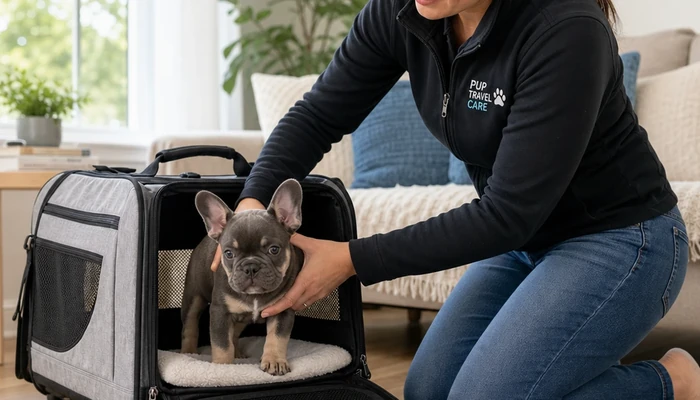
The carrier or restraint should be appropriate for the puppy’s size and the travel method, with secure closures and enough room for a comfortable natural posture. Airline size and construction requirements can be specific; confirm them before purchase. For a vehicle, the carrier should be secured so it cannot slide or tip if the driver brakes suddenly. Never accept a plan that allows the puppy to ride loose.
If the breeder and veterinarian agree, gentle, positive exposure to the carrier before departure may make it less unfamiliar. Keep these experiences short and calm. Do not force a tired or distressed puppy to remain in a carrier for practice, and do not add bedding or equipment that creates a chewing, overheating, or entanglement risk.
Plan for hygiene without overhandling
A young puppy may need opportunities to toilet, but each transfer creates a chance of escape or exposure to unfamiliar animals and public surfaces. Ask exactly where breaks will occur and how the caregiver will keep the puppy secure. The plan should balance basic comfort with appropriate disease precautions based on age and veterinary advice.
Bring only the supplies agreed with the breeder and carrier. This may include familiar bedding, suitable cleaning supplies, and a small amount of the puppy’s usual food if the caregiver needs it. Avoid offering unfamiliar treats or making major feeding changes on travel day. A veterinarian can advise on feeding timing for a particular trip and puppy.
Keep the journey calm rather than constantly stimulating
Repeatedly opening the carrier to show the puppy to people may increase stress and create handling risks. The caregiver should keep interactions calm, follow carrier rules, and observe the puppy without unnecessary disturbance. Noise reduction, a stable temperature, and a predictable routine can be more helpful than trying many new products or experiences on the day.
Share the puppy’s known comfort cues with the caregiver, such as how it responds to gentle handling or its familiar settling routine. Keep these notes factual and brief. A puppy is still an individual, and a new setting may change how it behaves.
Arrival handoff and the first day at home
Make the exchange calm and verifiable
Meet at the agreed location and confirm the puppy’s identity, records, and condition before the caregiver leaves. Ask for a concise account of the trip: duration, breaks, food or water offered, any unusual behavior, and any delays. If something seems unclear, contact the breeder rather than relying on assumptions. Avoid passing the puppy among a crowd or introducing it to resident pets immediately.
Observe the puppy’s breathing, alertness, movement, and willingness to settle. Travel can leave a puppy tired, but you know your new puppy only from the information provided, so report concerns promptly to the breeder and seek veterinary advice when appropriate. Do not wait for an online opinion if the puppy appears to have labored breathing, is unusually weak, collapses, or is otherwise in distress.
Keep the first hours quiet
Offer access to a calm, safe area and follow the breeder’s and veterinarian’s advice about water, food, toileting, and rest. Keep visitors, handling, and new experiences limited at first. If you have other pets, follow a gradual introduction plan and any health precautions advised by your veterinarian. The aim is not to complete every introduction on arrival day; it is to help the puppy recover from travel and begin learning the new routine.
- Set up a secure resting area before pickup.
- Have the puppy’s normal food and familiar care instructions ready.
- Keep the first outing and introductions simple and supervised.
- Record questions or changes in behavior to discuss with the breeder or veterinarian.
- Arrange the puppy’s first local veterinary appointment according to the breeder’s records and your veterinarian’s advice.
Preserve continuity after the ride
Responsible delivery does not end at the handoff. The buyer should know whom to contact about feeding, sleep, toileting, behavior, and records in the days that follow. A breeder who provides ongoing support can help explain what is normal for that puppy and when a veterinary check is prudent. For general preparation, see this resource on setting up a home for a new puppy.
Warning signs in a Frenchie delivery proposal
Promises that replace a real plan
Be cautious when a provider relies on slogans such as “VIP delivery,” “stress-free,” or “fully safe” but cannot describe the route, carrier, caregiver, and emergency response. No transport method can remove every risk. A trustworthy provider gives specific information and explains the limits of what they can control.
Missing people, gaps, or unexplained transfers
A puppy should not pass through a chain of unidentified people or locations without the buyer and breeder understanding who is responsible. Ask about every transfer, including airport pickup, vehicle changes, overnight care, and final delivery. If the provider cannot identify who has custody at each stage, do not treat the arrangement as ready.
Pressure to ignore weather or health changes
Urgency is not a welfare strategy. A provider who insists that travel must proceed despite a relevant health concern, a serious weather disruption, or a major route change should raise questions. The breeder, buyer, veterinarian, and transport provider should be able to pause and reconsider when circumstances change.
- No written itinerary, terms, or named day-of-travel contact.
- No clear answer about airline approval, vehicle arrangements, or puppy supervision.
- Promises that a French Bulldog puppy cannot experience breathing or heat problems.
- Refusal to explain emergency procedures or safe rescheduling.
- Pressure to send money before the provider and plan are verifiable.
- Advice to use medication without the puppy’s veterinarian.
One unanswered question does not automatically prove misconduct; some details may depend on a booking. However, you should receive a satisfactory answer before the puppy travels. If the plan remains vague, ask the breeder to help arrange a different provider or delay the trip.
A step-by-step decision framework for buyers
Step one: confirm the puppy is ready to travel
Ask the breeder and veterinarian to discuss the puppy’s health, age, and any individual concerns. Get clear instructions for travel day. If the puppy is unwell or the veterinary team advises postponement, do not let a prepaid booking override that guidance.
Step two: compare complete itineraries
Request a door-to-door plan from each provider. Include airport or road transfer time, waiting, breaks, connections, overnight care, and final handoff. Compare the puppy’s full period of travel and supervision rather than a headline flight time or mileage estimate.
Step three: evaluate handling and contingencies
Confirm who will be with the puppy, how it will be secured, how temperature and breaks will be managed, and what happens if the route changes. Make sure the provider can reach the breeder and buyer, and that there is a sensible route to veterinary care if needed.
Step four: choose the plan that fits this puppy
Decide with the breeder and, where appropriate, the veterinarian. A direct flight with a prepared attendant may suit one route. A well-managed road journey may suit another. A third route may need to wait for better weather or a different schedule. The safest decision is the one whose details match the puppy’s needs and the conditions—not the option with the most appealing name.
If you are still discussing whether a puppy is the right fit, you can review current puppy availability after considering health, timing, and your ability to provide long-term care.
Frequently asked questions about Frenchie puppy delivery
Is ground transport safer than a flight nanny for a French Bulldog?
Not automatically. Safety depends on the puppy’s health, the actual route, travel duration, weather, supervision, equipment, and contingency plans. Compare the complete arrangements and ask the puppy’s veterinarian whether there are individual concerns.
Can a French Bulldog puppy fly in an airplane cabin?
Some airline and route arrangements may allow an eligible puppy to travel in the cabin with an attendant, but policies differ and can change. The airline must confirm its current requirements for the exact booking, including age, carrier, size, and route. Never rely on a general claim that all French Bulldogs can fly in-cabin.
Does a flight nanny mean the puppy is supervised every minute?
The term alone does not define the service. Ask who accompanies the puppy, what happens during check-in and boarding, whether there are transfers, and how the puppy is monitored. Confirm the attendant’s responsibilities in writing.
What should a ground transporter provide before pickup?
Request a named caregiver, route and timing estimate, vehicle and restraint details, planned breaks, temperature precautions, communication process, emergency plan, and written terms. Also ask whether other animals or additional pickups are part of the trip.
How long can a Frenchie puppy travel in one day?
There is no universal time limit that is right for every puppy. Age, health, route, rest opportunities, weather, and the quality of care all matter. Ask the veterinarian familiar with the puppy to consider the specific itinerary and discuss whether it needs changes or a postponement.
Should a puppy be sedated for a flight or long drive?
Do not give sedatives or calming medication unless the puppy’s veterinarian recommends it for that individual animal and journey. Medication can affect alertness and breathing. The transporter should not independently prescribe or administer medication.
What if the puppy arrives tired or quiet?
Some tiredness after a journey may occur, but you should ask the caregiver what happened during travel and monitor the puppy closely. Contact the breeder or veterinarian if you are concerned. Labored breathing, collapse, marked weakness, or other signs of distress require prompt veterinary attention.
Can a breeder require the buyer to use a specific transport company?
Ask why that provider is preferred, what alternatives are acceptable, who contracts and pays for the service, and what the agreement says about delays or cancellation. Whatever the arrangement, the buyer should be able to understand who is responsible for the puppy and how its welfare is protected.
When should a delivery be postponed?
Postponement may be appropriate when the puppy is ill, a veterinarian advises against travel, severe weather changes the risk, the carrier cannot confirm its requirements, or the provider loses a safe route or caregiver. A responsible plan makes room for rescheduling when the puppy’s welfare calls for it.
Choose the journey that protects the puppy’s well-being
Ground Transport vs Flight Nanny: How Safe Frenchie Delivery Is Chosen is best answered by looking beyond the transport label. Evaluate the puppy’s breathing and health, the total door-to-door itinerary, weather and waiting, direct supervision, secure equipment, communication, and the provider’s response to unexpected changes. Ask for details in writing, involve the breeder and veterinarian, and be willing to adjust the date when the plan no longer fits the circumstances.
Neither a flight nanny nor ground transport can promise a risk-free journey. Careful planning can, however, help reduce avoidable stress and make responsibilities clear. When a provider welcomes informed questions and puts the puppy’s needs ahead of speed, you have a stronger basis for making a decision that supports a confident start in the new home.
About Elite Frenchies
Elite Frenchies is a French Bulldog breeding program focused on structure, temperament, health testing, responsible genetics, and owner education. The program emphasizes transparent communication about health, pedigree, contracts, and buyer expectations, along with early socialization and support for puppy owners after pickup. Elite Frenchies helps families and French Bulldog owners in United States and nearby areas with ethical breeding and lifelong support. Information in this article is educational and does not replace advice from a qualified veterinarian or the policies of an airline or transport provider.
efrenchies, available puppies ready now, available puppies with papers