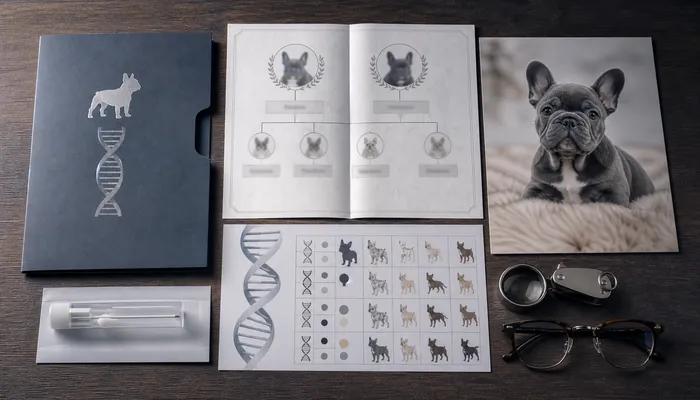
Photographs sell puppies, but they do not prove anything about them. A fluffy Isabella can look exactly like the puppy in the listing and still carry a different set of markers than the one described, and that gap between appearance and genetics is where most disappointing purchases begin. It is also why experienced buyers now ask for a French Bulldog DNA panel before they ask about availability. Anyone can type “rare lilac fluffy” into an ad. Very few breeders can send a report that shows the specific markers behind that claim.
The conversation has shifted accordingly. Buyers open with a request for documentation instead of a request for photos. They ask which lab ran the test, when the swab was collected and whether both parents were tested. That is a healthier starting point for everyone involved, because it moves the decision away from how a puppy photographs and toward what the genetics actually say.
A breeder who tests before listing should be able to send three things on request: the puppy’s panel, the parents’ panels and a plain-language explanation of what those results mean for the color you are pursuing. If one of those three is missing, that tells you something useful about the program.
Why Color Claims Need Paper Behind Them
Color descriptions written from a photograph are guesses. Sometimes they are accurate guesses made by someone who has watched a bloodline for years, and sometimes they are marketing. The problem for a buyer is that the two look identical in a message thread, and the difference only becomes visible later, when the puppy’s adult coat comes in or when a breeding plan does not produce what was promised.
Documentation removes that ambiguity. A written panel takes the question out of the seller’s hands and puts it into a lab report you can read yourself. That is the entire point: not that a breeder sounds trustworthy, but that you are not required to take their word for it.
The Loci That Decide a Fluffy Frenchie’s Coat and Color
Reading one of these reports does not require a genetics degree, but it does require knowing which lines to look at first. Four areas do most of the work when a buyer is evaluating an Isabella Fluffy, an Isabella Merle Fluffy or a Platinum Fluffy puppy.
The Coat-Length Gene and What a Carrier Result Means
The fluffy coat comes from the FGF5 coat-length gene. A puppy needs two copies of the long-coat variant to develop the visible fluffy coat. With one copy, the dog has a normal short coat but can pass the variant on, and that is what a fluffy carrier is. Two carriers can produce fluffy puppies, and a carrier bred to a visual fluffy can produce both in the same litter.
This is why the panel matters more than the eight-week photo. A short-coated puppy with a confirmed carrier result is not a lesser dog; it is a genetically documented one whose breeding value is known rather than assumed. Our breakdown of what DNA confirms about fluffy coats walks through those combinations in full.
The Markers Behind Isabella, Platinum and Lilac Tones
Isabella is not a single gene. It results from combining chocolate and blue dilution, which is why the tone reads as a warm, dusty grey with a lavender cast rather than a flat grey. The report shows the dilution markers behind blue-based coats and the cocoa markers behind chocolate, and the pairing of both is what points toward the Isabella expression. Platinum sits in the same family of low-pigment, diluted coats, with its own differences in intensity and in eye and nose pigment.
Read those lines together rather than individually. A puppy showing dilution without the cocoa side does not produce the same coat as one carrying both, and a description written from a photograph will not tell you which one you are looking at.
Merle Status and Why Pairings Are Tested
Merle is the marker most often misrepresented, sometimes honestly and sometimes not. The report gives merle its own locus and separates a dog that carries merle from a cryptic merle that shows little or no visible pattern, and from a dog that inherited merle from both sides. That last combination is a double merle, associated with known risks that include hearing and vision concerns. Responsible breeding avoids it by testing both dogs before a pairing is planned.
For an Isabella Merle Fluffy, this is the section to read most carefully. Our explainer on how merle results appear on a panel covers cryptic and double merle results in more depth.
Reading the Report Line by Line
Once you know which sections matter, reading a French Bulldog DNA panel is mechanical. Most confusion comes from mixing up two different kinds of information printed on the same page.
Genotype Versus Phenotype
Genotype is what the DNA says a dog carries. Phenotype is what you can see. A panel reports genotype; your eyes report phenotype. When a breeder says a puppy “is” Isabella, the only defensible version of that statement is genetic: the puppy carries the markers associated with the Isabella expression, confirmed by testing. Read the genotype lines, then look at the puppy, then decide whether the visible coat is the one you want. Only one of those two inputs is proof.
What Clear, Carrier and At-Risk Labels Mean
Results are typically reported as clear, carrier or affected, depending on the lab’s wording. Clear means the dog did not inherit the variant in question. Carrier means one copy, with no visible effect for a recessive trait like coat length, but meaningful if the dog will be bred. Affected means two copies, which for a health-related marker is a planning consideration rather than an automatic deal-breaker.
For a puppy you plan to keep as a companion, the coat and color lines matter most. For one you might breed later, the carrier and affected labels carry real weight. Read the report against your own plans rather than a generic checklist.
Spotting an Incomplete Panel
An incomplete panel is the most common problem buyers run into. A report may confirm coat length and say nothing about dilution, or list health screening while leaving merle unaddressed. If a breeder is advertising a Platinum Fluffy, the panel should address the dilution and cocoa markers behind that expression. If merle is anywhere in the conversation, merle status belongs on the page.
Ask directly: which loci were tested, and does the panel cover every trait named in the description? A breeder who knows the genetics answers that without hesitation.
Comparing Two Panels Before You Reserve
Comparing two French Bulldog DNA panels side by side is more useful than comparing two sets of photos. Coat length, dilution, cocoa and merle results should line up consistently across the puppy and both parents. A missing parent panel does not invalidate the puppy’s result, but it removes your ability to see how the pairing was planned.
Put your questions in writing and ask for answers in writing. “The puppy is a fluffy carrier, can you confirm which parent carries the long-coat variant?” is a fair question, and the answer should come quickly. Vague replies, delays or paperwork that belongs to a different dog are all worth noticing.
Panel results sit alongside registration paperwork, and the two are not interchangeable. A DNA report tells you what a dog carries; full registration versus limited registration determines what you can do with the lineage. Buyers who intend to breed should ask about both before a deposit changes hands.
What to Ask Before You Place a Deposit
A deposit should follow documentation, not the other way around. Before committing, ask for the puppy’s panel, the parents’ panels, the vaccination record, the veterinary health check and the pedigree. Ask whether the dog comes with full breeding rights or limited registration. Then ask what the panel does not cover, because a straight answer there says more than any polished listing.
For buyers in St. Louis, verification is where the remote process either earns your confidence or does not. There is no kennel to drive to in the Central West End or out past Chesterfield, and a breeder who implies otherwise is not being straight with you. The workable version of remote buying looks like live video calls with the puppy at whatever stage you need to see it, photo and video updates across development, and delivery coordinated by flight nanny into St. Louis Lambert International Airport when the puppy is ready to travel. Buyers in Clayton, Kirkwood, Webster Groves, Soulard and Tower Grove work through the same sequence, which exists precisely so that nobody has to reserve sight-unseen.
One honest note about the breed: French Bulldogs are brachycephalic and carry known health considerations that no panel changes. What DNA testing does is remove guesswork from coat and color claims and give you a documented starting point. It does not replace a veterinary relationship, and a breeder who implies otherwise is overselling.
When you are ready to talk about a specific line, tell the breeder what you are looking for, whether that is Isabella Fluffy, Isabella Merle Fluffy, Platinum Fluffy or a short-haired fluffy carrier, along with gender preference and timeline. These lines are planned around breeding cycles rather than kept in stock, so timing follows the litter calendar. Asking costs nothing, and you can request current pricing or ask which line is in development through https://efrenchies.com/contact/.
If you want to see how that documentation travels with a puppy from day one, start with the Fluffy French Bulldog lines that ship with verified DNA proof.