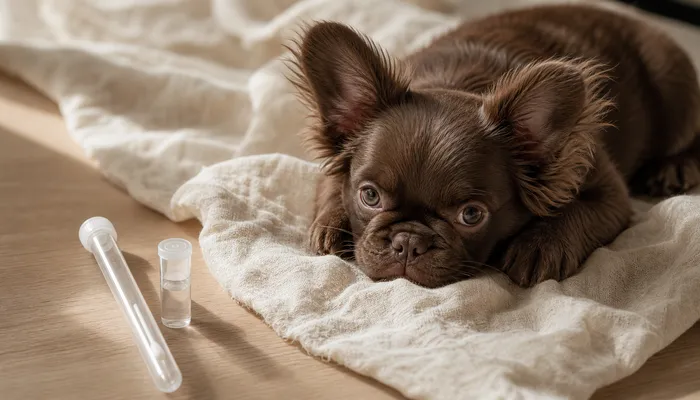
Two puppies from the same litter can leave the whelping box looking like they came from different parents. One is a short-coated fawn; the other carries a deep brown sheen with a coat long enough to fall softly over its ears. Neither result is random. Both are the predictable output of specific genes, and once you understand which genes are doing the work, the conversation around chocolate fluffy French Bulldog genetics stops being a debate about photographs and becomes a question of documentation.
Chocolate and fluffy are two separate genetic events that occasionally land in the same dog. That distinction matters, because a breeder who understands it can tell you which pairings might produce the combination — and a breeder who does not will describe a puppy’s color from memory and hope nobody asks for a panel result.
What “Chocolate” Actually Means in French Bulldog Genetics
Chocolate is not a pigment that gets mixed in; it is a pigment that gets switched. In French Bulldogs, the brown coat most people call chocolate comes from the b locus, often referred to as the cocoa gene. A dog that inherits two copies of the recessive b allele — written b/b — produces brown eumelanin instead of black. The change is not limited to the coat: nose leather, eye rims and paw pads shift to a matching brown tone, which is one reason a genuine cocoa dog looks consistent from head to tail rather than brown in one area and black in another.
Because the trait is recessive, a dog carrying a single copy (b/B) can look entirely black, blue or fawn and still pass cocoa on to its puppies. That hidden carrier status is invisible in a photograph. It is also the most common reason two “black” French Bulldogs can produce a chocolate puppy, and the reason pedigree color history alone cannot answer the question.
Cocoa, Chocolate and Brown Are Names for the Same Locus
Different registries, pedigrees and breeders use different words for the same genetic result. Cocoa, chocolate and brown all describe the same b locus expression. What changes is not the biology but the language built around it, which is why a serious buyer should ask for a panel that names the locus rather than a description that names a shade.
Where the Fluffy Coat Comes From: The FGF5 Long-Hair Gene
Coat length is inherited separately from color. The fluffy look in French Bulldogs traces to a variant in the FGF5 gene, the long-hair gene studied across many breeds. The long-haired version is recessive: a puppy must inherit the variant from both parents for the coat to express visibly. Inherit it from one parent only, and the dog looks like an ordinary short-coated French Bulldog while still being able to produce fluffy puppies later.
Fluffy Frenchies keep the breed’s body type, ears and expression. What changes is the coat itself — longer, softer, denser, with feathering that becomes obvious around the ears, chest and tail. Puppies that will eventually be fluffy often look plush rather than sleek in their first weeks, but appearance alone is not proof. The only reliable way to separate a visual fluffy from a carrier is testing.
Fluffy Visual Puppies vs Fluffy Carriers
A fluffy visual puppy carries two copies of the long-hair variant. A fluffy carrier carries one and looks short-haired for life. Both matter to a breeding program and to a buyer’s expectations, which is why programs working with these lines document carrier status instead of leaving it to guesswork. Short-haired carrier lines are also part of the conversation for buyers who want the genetics without the long coat, and they are generally described at a more accessible price point than the visual fluffy lines.
Why Chocolate Fluffy Puppies Are Rare and Planned, Not Produced on Demand
When two recessive traits have to line up in the same dog, the numbers work against volume. Both parents must carry the cocoa allele, both must carry the long-hair variant, and every puppy in the litter inherits its own independent draw from each parent. French Bulldogs also carry small litters by nature, often three to five puppies. Combine a low-probability genetic outcome with a low litter count and you get a coat combination that cannot be manufactured to a schedule.
This is why exotic lines are waitlist-based by design rather than stocked. A planned pairing may produce several visual fluffy puppies with no cocoa, or several cocoa puppies with short coats — neither outcome is a failure, it is inheritance behaving exactly as expected. Programs that know their lines plan around probabilities and breeding cycles. Programs that promise a specific color on a specific date are describing something biology has not agreed to.
How DNA Testing Confirms the Color Before a Puppy Is Listed
Testing happens before any color claim is made. A panel run on the parents and the puppies identifies the b locus and the FGF5 variant, alongside the merle locus and the health markers relevant to French Bulldogs. The result is a document, not an opinion: it tells you whether a puppy is b/b or b/B, whether it is a fluffy visual or a carrier, and whether a merle pattern is present, cryptic or absent altogether.
That last point deserves plain language. Merle is a striking pattern and a serious one. Breeding merle to merle carries known health risks, including auditory and ocular concerns, which is why pairings are tested and planned to avoid double merle combinations. If you want the full picture of how these patterns are inherited, our breakdown of how coat patterns are inherited walks through merle, cryptic merle and double merle in detail.
Buyers should also understand that inheritance is not the same thing as health. The French Bulldog is a brachycephalic breed with well-documented airway and joint considerations, and no DNA panel erases that reality. What testing does is replace guesswork with information — about color, about carrier status and about the markers a breeder can screen for. Our notes on health and unusual coat colors explain where genetics, breed structure and responsible planning genuinely separate.
Alongside DNA results, every puppy placed comes with AKC full registration including breeding rights, vaccination records up to date, a veterinary health check and AKC pedigree documentation. Together those documents answer the questions a serious buyer should be asking anyway, which is why no puppy is listed until they exist. If you have already run into listings where a rare color is asserted from a photograph with nothing behind it, this piece on how to spot color claims without evidence is a useful reference point.
What to Ask Before You Commit to a Chocolate Fluffy Puppy
Most of the confusion around chocolate fluffy French Bulldog genetics comes down to missing documents rather than missing knowledge, so start there. Ask what the panel says about the b locus, not what the coat looks like in natural light. Ask whether the puppy is a fluffy visual or a carrier, and ask to see the parent pairings that make that outcome possible. Ask for merle status in writing if the line involves merle at all. Ask how development will be documented between deposit and delivery, and ask what happens during the flight nanny handoff at your airport if you are buying from out of state.
Buyers in Columbus, OH often do exactly this research before contacting anyone, comparing what a program can prove against what a local listing simply states. The real question is not whether a chocolate fluffy French Bulldog exists — it does. It is whether the breeder can show you the genetics behind the one in front of you. You can see how we DNA-verify the fluffy lines we place in Columbus, which lines are currently planned and how the waitlist works once a pairing is confirmed.
If you are still deciding which line fits your home, tell us what you are comparing — cocoa, lilac, Isabella or platinum — and we will walk you through how each one is produced and what testing confirms it. If you would rather ask a direct question about a specific pairing, reach out through our contact page or call 708-637-0511. Tell us which color line interests you, whether you are looking for a puppy or a carrier, and roughly when you hope to bring one home. That is usually enough for us to tell you honestly whether your timing lines up with a planned litter or whether a waitlist is the realistic path.